



• slide1

    Venha fazer parte do CSLab.

    E deixe sua marca!

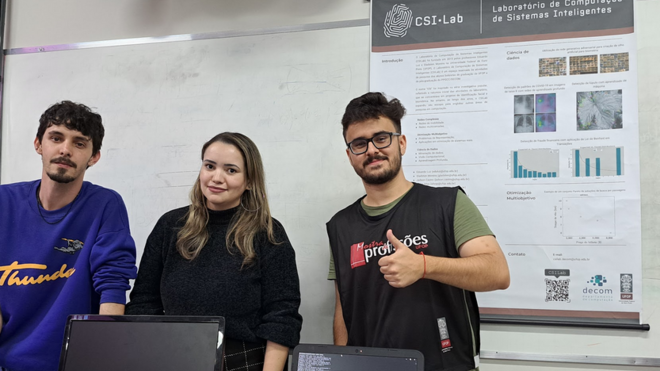
  • Mostra

    CSILab na Mostra de Profissões UFOP, Junho de 2023!

    Apresentando projetos inovadores desenvolvidos em suas áreas de pesquisa!

  • best 2023

    Deixamos nossa marca em 2023.

    Melhor IC no Encontro de Saberes UFOP na área de exatas!

  • ercas 2024

    Deixamos nossa marca em 2024.

    Melhor Artigo no ERCAS 2024 - IX Escola Regional de Computação Aplicada à Saúde.

Recent Publications

Guilherme O. Santos, Lucas S. Vieira, Giulio Rossetti, Carlos H. G. Ferreira, and Gladston J. P. Moreira. 2025. “A high-performance evolutionary multiobjective community detection algorithm.” Social Network Analysis and Mining, 15, 1, Pp. 110. Publisher's VersionAbstract
Community detection in complex networks is fundamental across social, biological, and technological domains. While traditional single-objective methods like Louvain and Leiden are computationally efficient, they suffer from resolution bias and structural degeneracy. Multi-objective evolutionary algorithms (MOEAs) address these limitations by simultaneously optimizing conflicting structural criteria, however, their high computational costs have historically limited their application to small networks. We present HP-MOCD, a High-Performance Evolutionary Multiobjective Community Detection Algorithm built on Non-dominated Sorting Genetic Algorithm II (NSGA-II), which overcomes these barriers through topology-aware genetic operators, full parallelization, and bit-level optimizations–achieving theoretical \$\$O(G \backslashcdot N\_p |V|)\$\$complexity. We conduct experiments on both synthetic and real-world networks. Results demonstrate strong scalability, with HP-MOCD processing networks of over 1,000,000 nodes while maintaining high quality across varying noise levels. It outperforms other MOEAs by more than 531 times in runtime on synthetic datasets, achieving runtimes as low as 57 s for graphs with 40,000 nodes on moderately powered hardware. Across 14 real-world networks, HP-MOCD was the only MOEA capable of processing the six largest datasets within reasonable time, with results competitive with single-objective approaches. Unlike single-solution methods, HP-MOCD produces a Pareto Front, enabling individual-specific trade-offs and providing decision-makers with a spectrum of high-quality community structures. It introduces the first open-source Python MOEA library compatible with networkx and igraph for large-scale community detection.
Gladston Moreira, Ivan Meneghini, and Elizabeth Wanner. 2026. “Maximum Dispersion, Maximum Concentration: Enhancing the Quality of MOP Solutions.” In Intelligent Systems, edited by Rosiane de Freitas and Diego Furtado, Pp. 150–165. Cham: Springer Nature Switzerland.Abstract
Multi-objective optimization problems (MOPs) often require a trade-off between conflicting objectives, maximizing diversity and convergence in the objective space. This study presents an approach to improve the quality of MOP solutions by optimizing the dispersion in the decision space and the convergence in a specific region of the objective space. Our approach defines a Region of Interest (ROI) based on a cone representing the decision maker's preferences in the objective space, while enhancing the dispersion of solutions in the decision space using a uniformity measure. Combining solution concentration in the objective space with dispersion in the decision space intensifies the search for Pareto-optimal solutions while increasing solution diversity. When combined, these characteristics improve the quality of solutions and avoid the bias caused by clustering solutions in a specific region of the decision space. Preliminary experiments suggest that this method enhances multi-objective optimization by generating solutions that effectively balance dispersion and concentration, thereby mitigating bias in the decision space.
Ivair R. Silva, Roger C.N. Ngassi, and Gladston J. P. Moreira. 2026. “Exact non-parametric sequential convergence test for samplers.” Journal of Computational and Applied Mathematics, 475, Pp. 117051. Publisher's VersionAbstract
Random number generators are extensively used in science. Generating pseudo-random numbers is the base for many data analysis techniques in computational statistics. This is the case, for instance, of most of the Bayesian methods, which are enabled by means of samplers such as the well-known Gibbs sampler and the Metropolis–Hastings. These classical Markov Chain Monte Carlo samplers are designed to generate a sequence of numbers that, under certain conditions, converge to a sequence that behaves as if sampled from a user-defined target distribution. In general, the number of iterations required to reach such convergence is not deterministic. There are several statistical tests for identifying that convergence has not yet been achieved, but not for actually signaling convergence. The present work introduces an exact non-parametric sequential test for signaling the convergence of random number generators in general. The solution is derived in the light of the type I error probability spending approach.
More