Note
Click here to download the full example code
Choosing a partition from a front
Take HP-MOCD's Pareto front on Zachary's karate club from
pymocd.hpmocd_fronts and pick one member in four
ways: three selection rules (maximum modularity, a target number of
communities, and RIMPSO's label-free rule through
pymocd.rimpso_select) and the ground-truth oracle.
The front
pymocd.hpmocd_fronts returns HP-MOCD's Pareto
front, the candidate set that pymocd.hpmocd selects from,
as a list of partitions. A front can list the same partition more than once,
so the code keeps one copy of each. HP-MOCD has no seed parameter, and its
module README records that two calls on the same graph differ, so the front
and every number on this page can change from one build of the documentation
to the next.
from collections import Counter

import matplotlib.pyplot as plt
import networkx as nx
import numpy as np

import pymocd

G = nx.karate_club_graph()
truth = {v: int(G.nodes[v]["club"] != "Mr. Hi") for v in G}  # the recorded split


def as_sets(partition):
    """dict[node, community] -> list of node sets, the form NetworkX expects."""
    groups = {}
    for v, c in partition.items():
        groups.setdefault(c, set()).add(v)
    return list(groups.values())


front, seen = [], set()
for p in pymocd.hpmocd_fronts(G):
    key = frozenset(map(frozenset, as_sets(p)))
    if key not in seen:
        seen.add(key)
        front.append(p)

k = np.array([len(set(p.values())) for p in front])
print(f"{len(front)} distinct partitions on the front, from {k.min()} to {k.max()} communities")
Out:
The objectives of each member
HP-MOCD minimizes the two objectives of
Shi et al. (2012):
\(\mathrm{intra}\), the fraction of edges that run between communities, and
\(\mathrm{inter} = \sum_c (d_c / 2m)^2\), where \(d_c\) is the degree sum of
community \(c\) and \(m\) the number of edges. Their sum is \(1 - Q\), with \(Q\) the
modularity (Core concepts). hpmocd_fronts returns
partitions only, so the code computes both objectives from these
definitions; the pymocd.HpMocd class returns them with
each member through
HpMocd.generate_pareto_front, from a
separate run. pymocd ignores edge weights, and NetworkX's karate graph has
them, so modularity is computed with weight=None.
m = G.number_of_edges()


def intra_inter(partition):
    internal = sum(partition[u] == partition[v] for u, v in G.edges())
    degree_sum = Counter()
    for v, d in G.degree():
        degree_sum[partition[v]] += d
    return 1 - internal / m, sum((d / (2 * m)) ** 2 for d in degree_sum.values())


intra, inter = np.array([intra_inter(p) for p in front]).T
Q = np.array([nx.community.modularity(G, as_sets(p), weight=None) for p in front])
ami = np.array([pymocd.ami(p, truth) for p in front])
print(f"largest |Q - (1 - intra - inter)| over the front: {np.abs(Q - (1 - intra - inter)).max():.1e}")
Out:
Four ways to choose
- Maximum modularity. The member with the highest \(Q\), the rule that
hpmocdapplies to its own front. - Closest to a target number of communities. The member whose number of communities is closest to a number fixed in advance, here 2, the number of factions the club split into; ties go to the higher \(Q\). The rule needs that number.
- RIMPSO's rule.
pymocd.rimpso_selectapplies RIMPSO's label-free selector, a degree-corrected assortative block model with a Schwarz penalty, to any list of candidate partitions. It returns a two-element list: the selected index and the[cut, pair]point of every candidate. - Front oracle. The member with the highest AMI against the recorded split. It reads the ground truth, so it is a yardstick for evaluation, not a rule that can be applied to a graph without labels.
target_k = 2
selected_index, cut_pair = pymocd.rimpso_select(G, front)

choices = {
    "maximum modularity": int(np.argmax(Q)),
    f"closest to k = {target_k}": min(range(len(front)), key=lambda i: (abs(k[i] - target_k), -Q[i])),
    "RIMPSO's rule": selected_index,
    "oracle (uses labels)": int(np.argmax(ami)),
}
print(f"rimpso_select: index {selected_index}, {len(cut_pair)} [cut, pair] points, "
      f"selected point {[round(x, 4) for x in cut_pair[selected_index]]}")

BLUE, ORANGE, AQUA, INK = "#2a78d6", "#eb6834", "#1baf7a", "#1a1a19"
style = {  # rule -> (color, ring size); rings of different sizes stay visible when choices coincide
    "maximum modularity": (BLUE, 420),
    f"closest to k = {target_k}": (ORANGE, 250),
    "RIMPSO's rule": (AQUA, 120),
}

fig, (ax_front, ax_bar) = plt.subplots(1, 2, figsize=(11, 4.4), gridspec_kw={"width_ratios": [1.25, 1]})

ax_front.scatter(intra, inter, s=22, color="#9a9994", zorder=2, label="front member")
q_best = Q[choices["maximum modularity"]]
line = np.linspace(0, 1, 2)
ax_front.plot(line, 1 - q_best - line, color=BLUE, lw=1, ls="--", zorder=1,
              label=r"$\mathrm{intra} + \mathrm{inter} = 1 - Q_{\max}$")
for name, (color, size) in style.items():
    i = choices[name]
    ax_front.scatter(intra[i], inter[i], s=size, facecolors="none", edgecolors=color,
                     linewidths=2, zorder=3, label=name)
i = choices["oracle (uses labels)"]
ax_front.scatter(intra[i], inter[i], s=110, marker="*", color=INK, zorder=4, label="oracle (uses labels)")
ax_front.set_xlim(-0.03, max(intra) + 0.05)
ax_front.set_ylim(-0.03, 1.05)
ax_front.set_xlabel("intra  (fraction of edges between communities)")
ax_front.set_ylabel("inter  (sum of squared degree shares)")
ax_front.set_title("HP-MOCD's front on the karate club", fontsize=11)
ax_front.legend(loc="upper right", fontsize=8, frameon=False)

names = list(choices)
values = [ami[choices[name]] for name in names]
colors = [style[name][0] for name in names[:-1]] + ["white"]
bars = ax_bar.bar(range(len(names)), values, width=0.6, color=colors, edgecolor=colors[:-1] + [INK],
                  linewidth=1.2, zorder=2)
bars[-1].set_hatch("//")
for x, value in enumerate(values):
    ax_bar.text(x, value + 0.02, f"{value:.3f}", ha="center", va="bottom", fontsize=9, color=INK)
ax_bar.set_xticks(range(len(names)), [name.replace(" (", "\n(").replace(" to ", " to\n") for name in names],
                  fontsize=8)
ax_bar.set_ylim(min(0, min(values)) - 0.02, 1.08)
ax_bar.set_ylabel("AMI against the recorded split")
ax_bar.set_title("Agreement of each choice with the split", fontsize=11)
ax_bar.grid(axis="y", color="#e4e3df", lw=0.8, zorder=0)
for ax in (ax_front, ax_bar):
    ax.spines[["top", "right"]].set_visible(False)
fig.tight_layout()
plt.show()
Out:
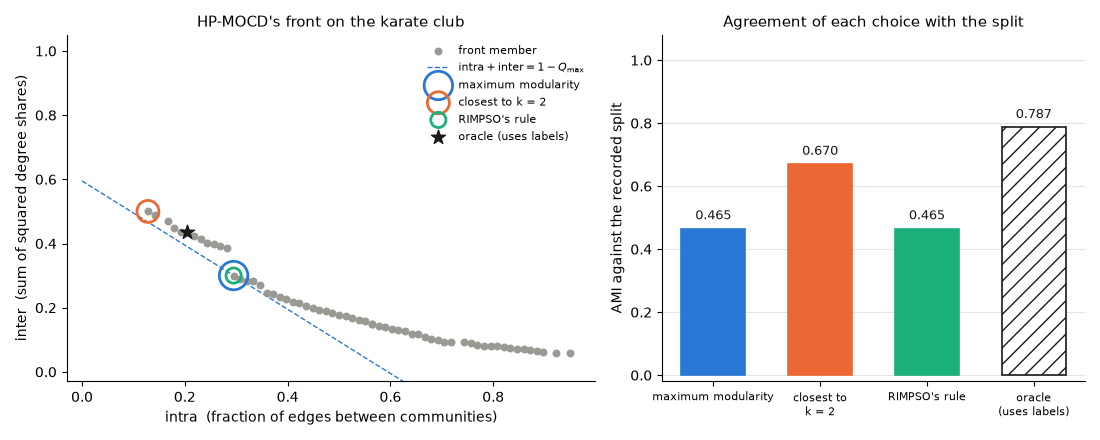
The dashed line is a level set of modularity: every point on it has the same \(Q\) as the maximum-modularity member, and the rest of the front lies on or above it. The table lists each choice with its index in the de-duplicated front, its number of communities \(k\), its modularity and its AMI.
print(f"{'rule':<22} {'member':>6} {'k':>3} {'Q':>7} {'AMI':>6}")
for name, i in choices.items():
    print(f"{name:<22} {i:>6} {k[i]:>3} {Q[i]:>7.4f} {ami[i]:>6.3f}")
Out:
rule                   member   k       Q    AMI
maximum modularity          3   4  0.4050  0.465
closest to k = 2            0   2  0.3718  0.670
RIMPSO's rule               3   4  0.4050  0.465
oracle (uses labels)       31   5  0.3600  0.787
Reading the result
The oracle is the maximum AMI over the front, so no rule applied to this front can score above its bar against the same reference; the gap between another bar and the oracle's is what that rule leaves behind on this front. Several members can share a number of communities with different AMI, so the member closest to the target \(k\) need not be the recorded split. When two rules pick the same member, its rings overlap in the left panel and the two rows of the table agree.
One front of one nondeterministic run on a 34-node graph says little about how the rules compare in general. Working with Pareto fronts covers each rule in more detail, and RIMPSO's resolution profile shows the RIMPSO selector on RIMPSO's own front.
Total running time of the script: ( 0 minutes 0.287 seconds)
Download Python source code: plot_choosing_from_front.py